
Construction Debris Removal on Staten Island
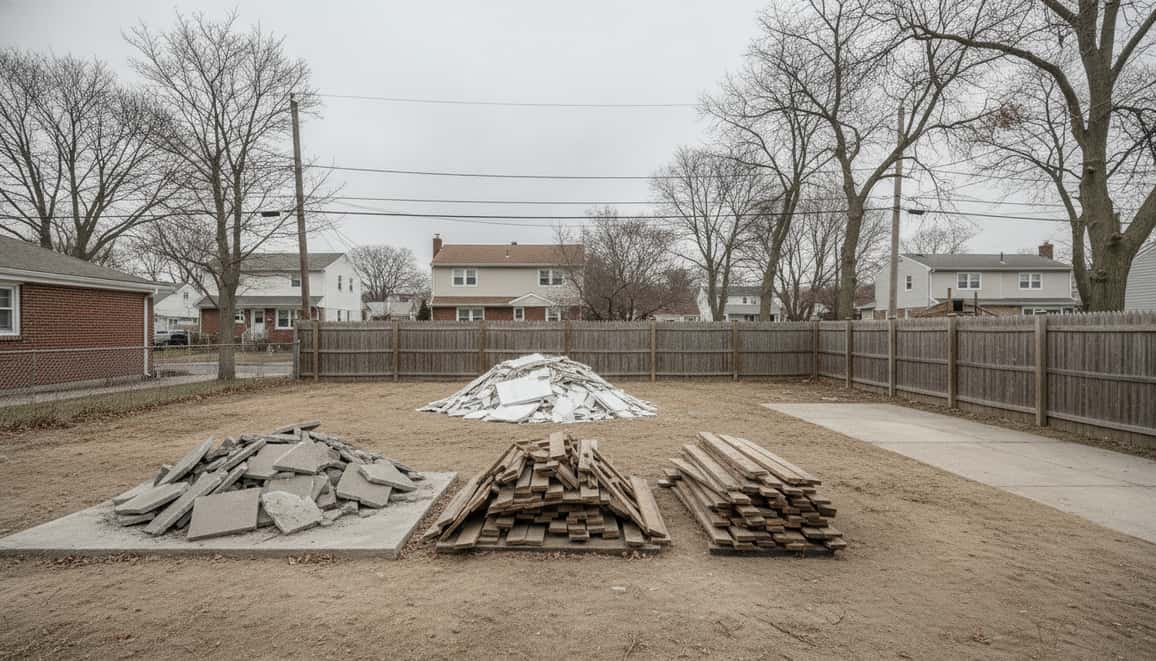
If there is already a pile on the property, you do not need a demolition to get rid of it. Describe what is there and we will tell you what moving it involves.
On its own, whoever broke it up
A finished job, a contractor gone, a property bought with a pile on it.
You do not need to have hired us for the demolition. If a job has finished and left you with the material, clearing it is a job in itself, and a common one.
It is the same work whether it came out of our own demolition or somebody else’s, and it is quoted the same way. A contractor who has gone, a job that ran out of budget before the last stage, a property bought with a pile already on it. All of those are ordinary here.
What counts, and what it weighs
Demolition arisings, in the four groups that decide how they travel.
Light and bulky
Timber framing, plaster and board, cabinetry, insulation, roofing felt. Fills a truck by volume long before it troubles the weight limit. This is most of what an interior job produces.
Heavy and dense
Concrete, brick, masonry, tile, old footings. The opposite problem. The truck is full by weight with the bed barely covered, so the load count is set by the scale rather than by the eye.
Awkward
Fixtures, tubs, boilers, tanks, long runs of conduit and pipe. Nothing about these is heavy. Everything about them is difficult to carry through a door and stack in a truck.
Mixed, as found
Which is what a real pile is. Sorted as it goes where sorting is possible, because a sorted load travels better and a mixed one does not get cheaper by being ignored.
Tell us what is on the property.
Whoever did the demolition. Roughly what is there and whether a truck can get in.
Loads, not bags
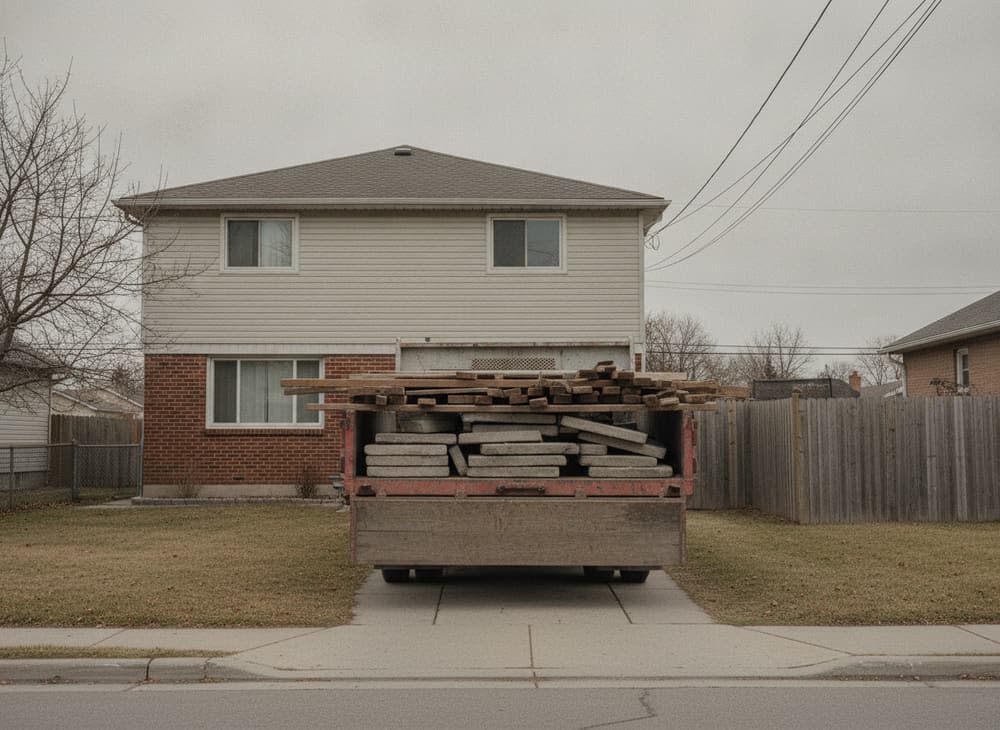
The answer to how much there is is a load count, and it is the thing people misjudge most, in both directions. A pile is bigger than it looks from the street almost every time, and a room full of board is smaller than it feels.
What decides the number is how much material there is, what it is made of, how far it has to travel from where it sits to a truck, and how much the access lets us move in one movement. Those are the four things we look at on the visit, and the figure follows from them.
Access decides the day
How far the material travels, and what the surface will carry.
On a lot with one driveway, how the material gets from where it is to the truck decides how long the job takes and what it costs. Whether a truck can turn, what the surface will carry, and how close it can get to the pile are the questions worth asking before quoting, not after.
Staten Island does not answer those questions the same way twice. The island’s high ground runs through the middle and the north and the south end sits below it, so the same pile can mean a graded haul up to the street on one property and a flat run across the lot on the next.
How a clearance runs
Four stages, and the last one is the one that gets skipped by everybody else.
-
Look at the access
Where the material is, and the route from there to a truck. This is the visit that turns a description into a load count.
-
Load
Sorted as it goes, where sorting is possible, and stacked rather than thrown so a load carries what it should.
-
Haul
Off the property in as few movements as the access allows, and away to a facility that takes construction and demolition material.
-
Level
Clearing is not the same as emptying. The ground goes back level and clear.
What the property looks like afterwards
The ground under a pile is rutted and full of small pieces.
Where the pile has been sitting, the ground under it is pressed down and rutted, and it is usually full of small pieces worked into the surface. We rake that back out level and pick up the small material, the nails and the broken board ends included, because that is the ground somebody walks on next.
Clearing a pile also means moving heavy material across ground the owner has to keep using afterwards. We protect the driveway and the lawn along the route out, work in loads the surface will carry, and leave the parts of the property we crossed the way we found them.
Questions we get asked
Will you take it away if someone else knocked it down?
Yes. That is a job on its own and a common one.
Tell us roughly what is there, whether it is one pile or spread across the lot, and whether a truck can get onto the property. Everything else we work out when we look at it.
How do you price a clearance?
We look at it first. The figure comes from how much material there is, what it is made of, how far it has to travel from where it sits to a truck, and how much the access lets us move in one load.
Volume is what people misjudge most, in both directions, so we work it out on the property rather than from a description.
What do you need to know before you can quote a clearance?
Roughly what is there and what it is made of. Whether it is one pile or spread across the lot. Whether a truck can get onto the property, and what the surface between the pile and the truck will carry.
We measure it on site, because a pile is bigger than it looks from the street almost every time.
How long will a truck be outside?
As short as the access allows, which is the honest answer and also the reason we look at the route before quoting.
On a property where the truck can get close to the material, most of a day is loading and the truck moves a handful of times. Where everything has to be carried out to the kerb, the truck is there longer and there are more movements. We tell you which of those your property is.
Tell us what needs clearing
Whoever did the demolition, describe what is on the property and we will come and look.